By Ray Baker
Examples of visual arts works include paintings, sculptures, photographs, and other types of works [1]. That legal clue tells you something important about what is fine art photography: photography can be fine art, not just wedding coverage or product shots. Many photographers still struggle to define what is fine art photography, though, and that confusion shows up in pricing, portfolios and client conversations.
What is fine art photography?
When considering what is fine art photography, it is photography created primarily as an expressive work: the photographer’s intent, concept and visual voice drive the image rather than a client’s commercial brief. It often overlaps with gallery prints, limited editions and personal projects, and copyright law recognises photographs as part of the visual arts.
Key takeaways
- Fine art photography values concept, intent and personal expression over purely commercial use.
- The Copyright Act states that pictorial, graphic, and sculptural works include photographs and prints [1].
- You do not need gallery representation to start; a consistent body of work and clear pricing matter.
- Market research lets you reduce risks even while your business is still just a gleam in your eye [2].
- There are no legal rules permitting the use of a specific number of words or percentage of a work under fair use [3].
Need a clear pricing path? The eBook walks through licensing, print pricing and client conversations without guesswork.
Read the pricing chaptersWhat makes a photo fine art?
I use a simple test: would the image still hold a wall if nobody paid you to take it? That does not mean commercial work cannot be artistic, but fine art usually starts with a personal concept, a consistent mood, or a question you want the viewer to sit with. If you are still finding your visual direction, the guide on how to become a fine art photographer can help you shape that path.
The legal definition is broad. The Copyright Act states that pictorial, graphic, and sculptural works include works of fine, graphic, and applied art, photographs, prints and art reproductions [1]. That means you can register a photograph as a visual arts work and treat limited edition prints like other visual art products. The label is not tied to subject matter: an abstract still life, a landscape, a portrait, or a documentary image can be fine art when the intent is expressive and the series feels cohesive. Consistency matters more than a single standout image. A buyer who sees twelve related frames understands your point of view faster than one who sees a random portfolio.
How does it differ from commercial work?
Commercial work usually starts with a client’s problem: sell a product, illustrate a story, or fill a magazine page. Fine art work usually starts with your own brief, and the buyer enters after the image is made. That changes the sales conversation. You are not selling service hours as much as you are selling a point of view, a print, or a licence to display a specific image.
This difference also changes how you edit. A commercial photographer may shoot many variations for a brand. A fine art photographer may spend a long time on one image, then print only a small set. Keep that distinction clear in your quotes and in your portfolio.
Want a business setup checklist? Turn your fine art series into a registered, sale-ready business with plain English steps.
Get the setup checklistHow do you price fine art prints?
Pricing is where I see photographers undercharge. Start with market research, not emotion. The SBA suggests answering questions on demand, market saturation (how many similar options are already available), pricing (what potential customers pay for alternatives), and location (where do your customers live) [2]. Use those answers to separate your work into small open editions, limited editions, and one-off originals. For the full setup path, read how to start a fine art photography business.
Then add your production costs, time and a fair margin. You may not get it perfect on the first run, and that is fine. The goal is a repeatable pricing formula you can adjust as demand changes.
5 easy tips for a stronger fine art portfolio
- Pick one concept. A small series on a single theme reads as art more than fifty scattered favourites.
- Print test images. Colour and texture change at full size, so look before you sell.
- Write a one-sentence artist statement. It helps buyers, galleries and your own editing.
- Protect published work. The Copyright Office has a Group Registration of Two-Dimensional Artwork (GR2D) application for between 2 and 20 published two-dimensional artworks created by the same author [1].
- Check your market. Answer questions about demand, market saturation, and pricing to get a good sense of your market [2].
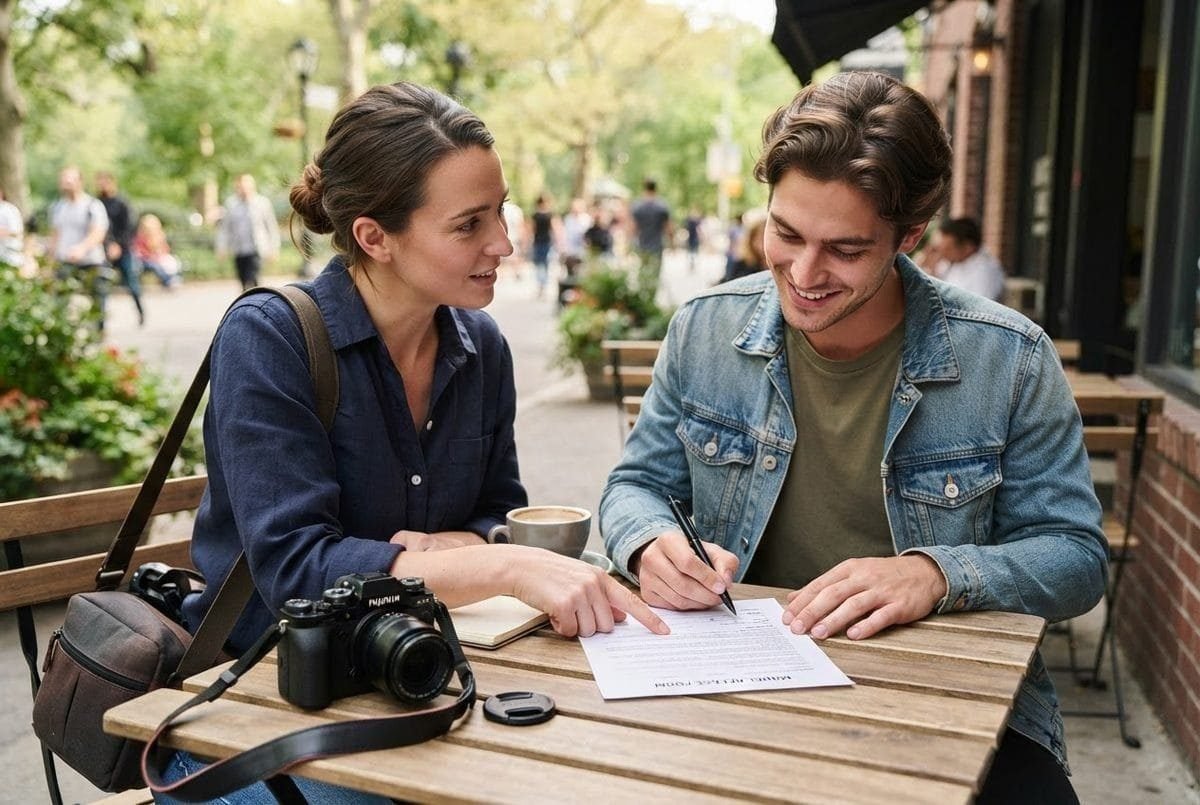
Need model releases and contracts? Plain English templates help you protect your work and sell prints without legal worry.
See the formsHow do you stand out?
Competitive analysis helps you make your business unique [2]. Look at other photographers who sell in the same space and ask what they do not offer. Maybe your angle is small-town landscapes, hand-painted frame options, or a written story with every print. You do not need to be the cheapest; you need a small wedge that buyers remember.
Keep notes in one place. When a gallery or buyer asks what you do, your answer should be one clear sentence, not a list of everything you can shoot.
Can you photograph someone else’s artwork?
Only with permission, unless a specific exception applies. Under the fair use doctrine, it is permissible to use limited portions of a work for purposes such as commentary, criticism, news reporting, and scholarly reports, but there are no legal rules permitting the use of a specific number of words or percentage of a work [3]. You cannot copy a painting, change a few details, and claim it as your own. The Copyright Office states you cannot claim copyright to another’s work, no matter how much you change it, unless you have the owner’s consent [3].
If your fine art project involves another creator’s sculpture, mural or print, get written consent first. A simple release or licence can save you from a copyright dispute later.
Should you register a business?
If you plan to sell prints consistently, treat it as a small business from the start. Your business location determines the taxes, zoning laws, and regulations your business will be subject to, and you’ll need to register your business, pay taxes, and get licenses and permits in the place you choose to locate your business [4]. This protects your personal finances and makes tax time simpler.
A shopfront is not needed. You might have fewer zoning restrictions if you base your business out of your home, but zoning ordinances can still apply even to home-based businesses [4]. It also signals to buyers that you are taking the work seriously.
Where can you get business help?
You do not have to figure this out alone, and a full-time advisor is not required. Professional bodies offer education and legal resources. ASMP describes a community of more than 7,500 Members and an Academy with detailed coursework on Marketing, Negotiation, and a Complete Copyright Curriculum [5]. ASMP also notes 38 local chapters across the United States and members in 70 countries, so local support is possible [5]. PPA lists education, business tools, legal protection and equipment insurance among its member benefits [6].
Learn about the paperwork and processes you need to take care of before you can start doing business, and check local zoning requirements [4]. Then add the help you actually need, whether that is legal templates, a local chapter, or a short course on pricing.
Related reading
- How to Become a Fine Art Photographer: Artist-side path and portfolio direction
- How to start a fine art photography business: Step-by-step business setup for fine art photographers
Frequently asked questions
Is fine art photography just black and white landscapes?
No. The medium and subject do not define it. A colourful still life, a documentary portrait, an abstract interior, or a staged self-portrait can all be fine art. The common thread is intent and a coherent visual idea.
Do I need a degree to be a fine art photographer?
No. A degree can help with contacts and critique, but many buyers and galleries respond to a consistent body of work and clear pricing. What matters is whether your portfolio shows a repeatable point of view rather than a one-off lucky shot.
Can I sell fine art prints without registering copyright?
You can sell, but registration gives you stronger enforcement options if someone infringes. For between 2 and 20 published two-dimensional artworks created by the same author, there is a Group Registration of Two-Dimensional Artwork (GR2D) application [1].
What should I charge for a limited edition print?
Research similar photographers first. Ask what potential customers pay for alternatives, how many similar options are already available to consumers, and where your customers live and where your business can reach [2]. Then add production costs, time and a margin, and revisit each series.
Should I start with a series or single images?
A small series usually works better. It shows you can sustain an idea, gives buyers a reason to collect more than one, and makes your portfolio easier to talk about. Start with a handful of images, then refine.
Do galleries expect a specific print size?
Not always. Some prefer standard frames and smaller editions, while others want large statement pieces. Research the gallery and ask for their submission guidelines before you print a full set.
Honest take
My honest take on what is fine art photography is that the label matters less than the work. Create a small series with a clear idea, price it using real market research, and protect the finished prints. If you do those three things, you will sound like one because you will be running such a business.
References
- U.S. Copyright Office. Visual Arts: Registration. https://www.copyright.gov/registration/visual-arts/
- U.S. Small Business Administration. Plan your business. https://www.sba.gov/counseling/plan-your-business/#market-research
- U.S. Copyright Office. Fair Use FAQ. https://www.copyright.gov/help/faq/faq-fairuse.html
- U.S. Small Business Administration. Launch your business. https://www.sba.gov/counseling/launch-your-business/#register-business
- American Society of Media Photographers. American Society of Media Photographers. https://www.asmp.org/
- Professional Photographers of America. Professional Photographers of America. https://www.ppa.com/
Shoot well and follow up faster,
Ray Baker