By Ray Baker
You type “studio photography courses near me” into Google and get a wall of results, local community colleges, a photographer two towns over advertising a weekend workshop, and a dozen online platforms promising to teach you lighting from your couch. The problem isn’t finding options. It’s figuring out which one will actually make you better behind the camera instead of just lighter in the wallet. Most photographers searching for studio photography courses near me are looking for one specific thing: hands-on time with real lights, real subjects, and someone experienced enough to correct their mistakes in the moment. That’s a different animal from watching a video or reading a blog post. This guide breaks down what to look for, what to skip, and how to turn a local workshop into skills that pay for themselves.
What should I look for in studio photography courses near me?
Look for hands-on practice with real lighting equipment, small class sizes, and instructors who shoot professionally. The best courses let you set up lights, pose subjects, and make mistakes under supervision. Avoid anything where you mostly watch someone else shoot, you learn studio work by doing it, not observing it.
That last point matters more than most people realize. A class where the instructor demos everything while you take notes feels productive, but you walk away without muscle memory. The PPA’s Studio Lighting for People Portraits class is explicit about this: it’s “NOT a sit back and watch experience,” and the primary goal is getting attendees comfortable using studio lighting by actually doing it [1]. That’s the standard you should hold every local course to.
Want to make your studio sessions more profitable? My eBook covers pricing and licensing in plain English.
See the eBookKey takeaways
- Prioritize courses with hands-on lighting practice over lecture-style demos.
- Small class sizes mean more individual feedback on your setup and posing.
- In-person workshops from organizations like PPA run twice a year across the country.
- Online options work well for theory, but studio lighting benefits from in-person reps.
- Check whether the course covers business topics alongside lighting and posing.
In-person vs. online courses
If you’ve never touched a strobe or softbox, in-person is almost always the better starting point. You need to feel how light falls, see how small changes in distance affect the look, and get corrected when your key light is in the wrong place. That feedback loop is hard to replicate through a screen.
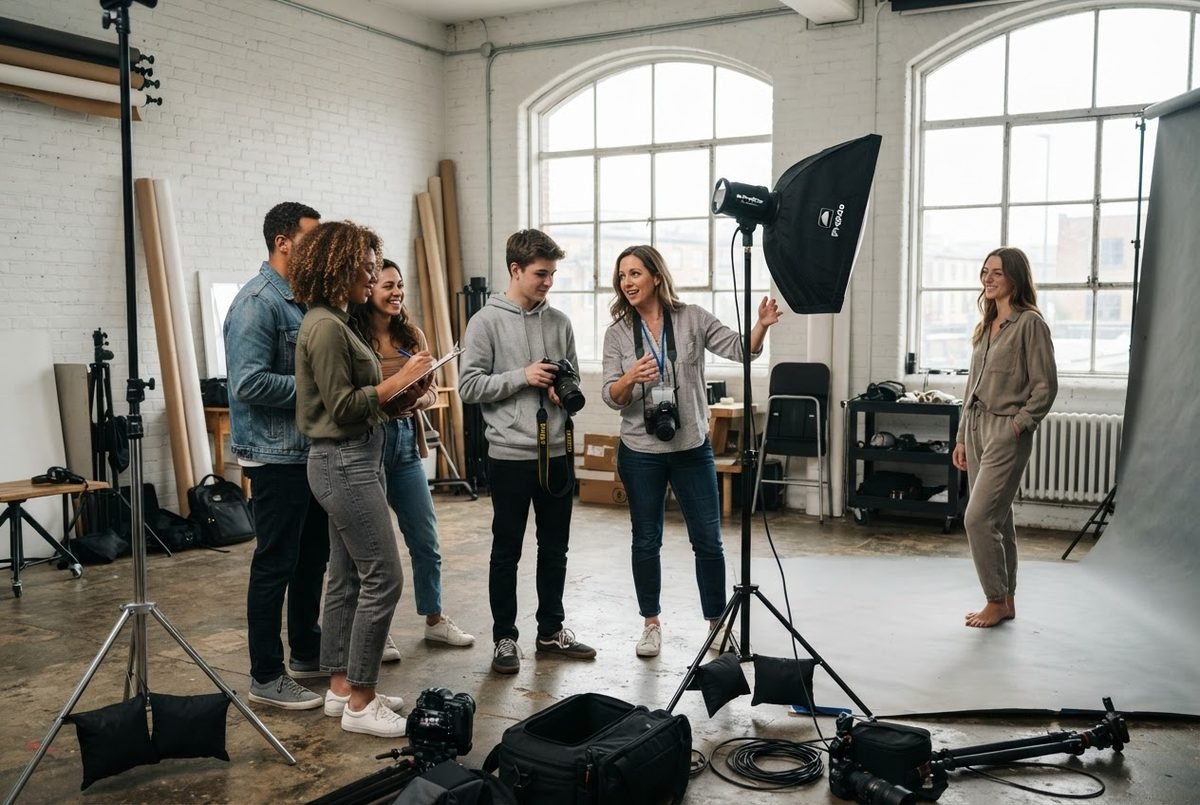
PPA runs photography workshops twice a year, once in spring and once in fall, with dozens of studios hosting day-long sessions across the United States [2]. For anyone searching for studio photography courses near me, these twice-yearly sessions are often the most practical starting point. These are peer-to-peer, taught by working photographers, and you don’t need to be a PPA member to attend [2]. Topics range from studio and portrait lighting to corporate headshots to business and marketing bootcamps [2]. That variety matters because studio photography isn’t just about lighting, it’s about running a studio.
Online courses make more sense when you already understand the basics and want to fill specific gaps. PPA’s PhotoVision platform offers on-demand training covering lighting, posing, composition, marketing, and pricing, and it’s included with PPA membership [3]. If you’re not a member, it runs a few dollars a month or a flat annual rate [3]. That’s a reasonable supplement to in-person training, not a replacement for it. If you want a broader look at what’s available remotely, our guide to online photography courses covers the landscape.
What a good workshop covers
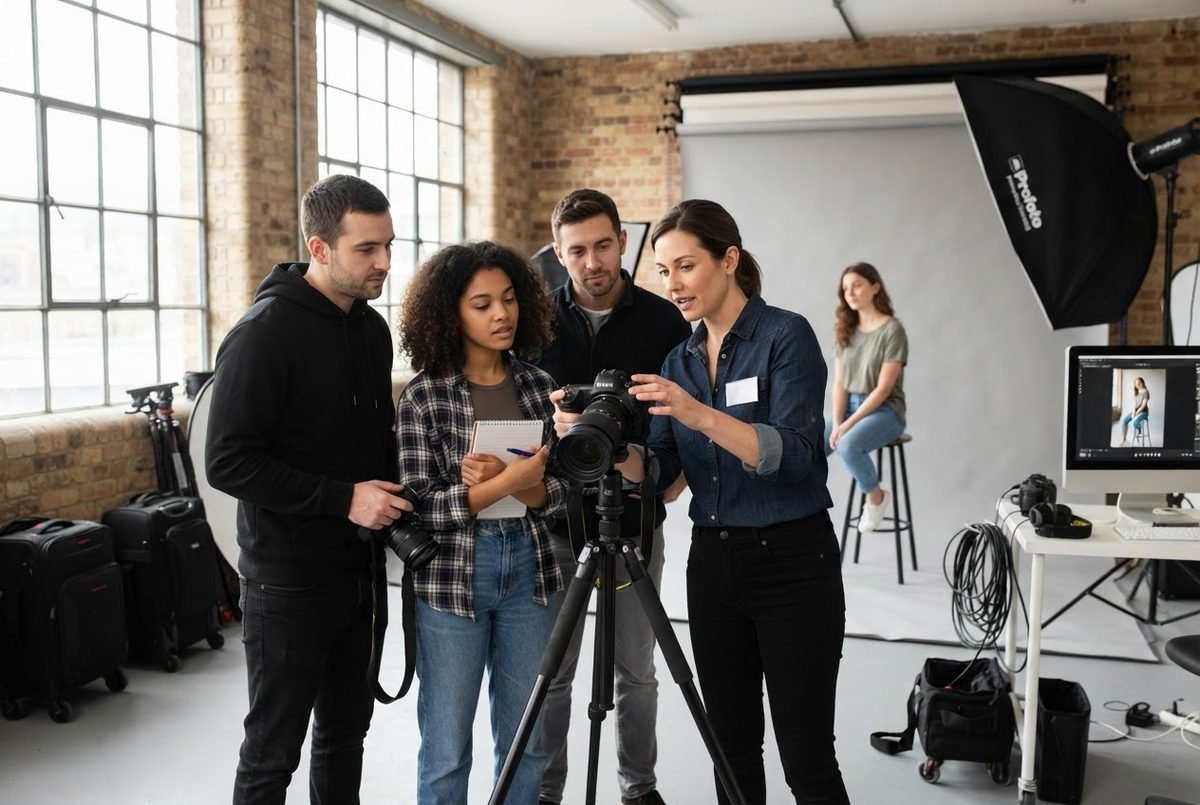
The best ones combine lighting, posing, and the business side. PPA’s Studio Photography Lighting, Posing, and Editing for Profit course is a good example, it walks through how lighting, posing, and editing work together to create an efficient and profitable business, showing how one studio space can shift from business headshots to children’s portraits to commercial product work [4].
That range is worth paying attention to. If you’re going to invest time and money into studio photography courses near me, you want them to expand what you can offer clients, not just teach you one setup you’ll use once. The same course covers headshot posing techniques, lens choices, lighting placement, and client interaction strategies that help subjects feel comfortable [4]. Those soft skills, getting people to relax in front of a camera, are often what separates photographers who book consistently from those who don’t.
Struggling to find consistent clients? My guide shows you how to attract and keep bookings.
Read the guideHow do you find workshops in your area?
PPA maintains a searchable directory of in-person workshops, with sessions running for two weeks in May and September each year [5]. Registration typically opens a couple of months ahead, and early registration usually costs less than showing up on-site [5]. PPA members get a service merit for each class attended, though membership isn’t required [5].
Beyond PPA, look at regional photography schools. Many people searching for studio photography courses near me overlook regional schools like these. PPA’s Community Network Schools provide educational opportunities on a statewide or regional basis, typically during one week of the year, and they’re a practical way to meet other photographers in your area [6]. Examples include the Mid-Atlantic Regional School and the Texas School of Professional Photography [6]. These tend to be more intensive than a single-day workshop and often draw attendees from across a region.
Local camera stores, community colleges, and established studio photographers also run courses. The quality varies wildly, so ask specific questions before booking: How many students per instructor? How much time is hands-on versus lecture? What equipment is provided? Can you see a sample schedule?
What should you bring and prepare before the course?
Bring your camera and a lens you actually use for portraits, usually something in the 50mm to 85mm range on full frame. Bring spare batteries and memory cards. If you have a speedlight or strobe, bring it, but don’t assume you’ll need it; most workshops provide studio lighting equipment.
More importantly, come with questions. If you’ve booked studio photography courses near me before, you’ll know the value of arriving with specific problems to solve. Think about the specific problems you’ve had in your own work: inconsistent exposure, unflattering shadows, subjects who look stiff. Write them down. A good instructor will address them during the hands-on portions, and you’ll get more value from the day.
If you’re planning to build or upgrade a home studio after the course, our guide to photography studio setup ideas covers small spaces and budget-friendly configurations.
Ready to simplify the business side? Learn client-getting, pricing, and releases without the fluff.
Get the eBookTurning course skills into paying work
A workshop is only worth it if it changes what you can charge or how efficiently you work. The studio photography courses near me worth taking do more than teach setups: they change how you run a session. Practice the setups you learned until they’re automatic. Then update your portfolio with images that reflect your new capabilities.
Pricing is the next step. If you can now deliver consistent studio headshots or family portraits that you couldn’t before, your packages should reflect that. Our guide to photography packages pricing walks through how to structure sessions and products so you’re not leaving money on the table.
And if the course inspired you to go further, maybe rent a space or build out a dedicated studio, our article on how to start a photography studio covers the practical steps from finding space to getting your first paying clients through the door.
Related reading
- Online Photography Courses: List of online courses for learning photography from home.
- Photography Studio Setup Ideas For Small Spaces And Home Studios: Related reading: Photography Studio Setup Ideas For Small Spaces And Home Studios
- Photography Packages Pricing: A Complete Guide: Guide to pricing photography services to match your new skills.
- How to start a photography studio: Steps to turn studio skills into a full-time business.
Frequently asked questions
Are studio photography courses near me worth the money?
Yes, if they’re hands-on and taught by working professionals. The value comes from supervised practice and immediate feedback, which is hard to get on your own. A course that’s mostly lecture is usually not worth the investment.
Do I need my own studio lighting equipment to take a course?
No. Most in-person workshops provide lights, modifiers, and backdrops. Check with the instructor beforehand, but generally you only need your camera and lenses.
How long are typical studio photography workshops?
PPA workshops are typically day-long sessions [2]. Regional schools may run for a full week [6]. Online courses are self-paced and can be completed over any timeframe.
Can I learn studio photography entirely online?
You can learn the theory and see demonstrations, but hands-on lighting skills develop faster with in-person practice. A combination of online learning and at least one in-person workshop is ideal.
Do I need to be a PPA member to attend their workshops?
No. PPA workshops are open to members and non-members alike [2][5]. Members receive a service merit for each class attended, but membership is not required to register.
Honest take
Searching for studio photography courses near me usually surfaces more options than you need, and not all of them are good. The ones worth your time share a few traits: they’re hands-on, they’re taught by people who actually shoot for a living, and they cover the business side alongside the creative. If a course promises to teach you studio lighting but won’t let you touch the lights, skip it. If it’s a full day of watching someone else work, skip that too.
The photographers who improve fastest are the ones who treat education as an ongoing expense, not a one-time event. Take a local workshop, practice what you learned, then take another one when you hit the next plateau. Pair that with online learning for the topics you can absorb at your own pace, and you’ll build studio skills that hold up under real client pressure, not just in a classroom.
References
- Professional Photographers of America. Studio Lighting for People Portraits Class. 2026. https://www.ppa.com/events/event/boost-your-confidence-with-studio-lighting-for-people-portraits-9-12-2026
- Professional Photographers of America. Fall Photography Workshops. 2026. https://www.ppa.com/articles/register-today-for-fall-photography-workshops
- Professional Photographers of America. Online Photography Courses, Tutorials & Education | PhotoVision. n.d. https://www.ppa.com/photovision
- Professional Photographers of America. Studio Photography Lighting, Posing, and Editing for Profit. 2026. https://www.ppa.com/photovision/watch/studio-photography-lighting-posing-and-editing-for-profit
- Professional Photographers of America. Find In-Person Photography Workshops Near You. 2027. https://www.ppa.com/events/photography-workshops/find-a-workshop
- Community Network Schools | Professional Photographers of America. https://www.ppa.com/community-networks/community-network-schools
Shoot well and follow up faster,
Ray Baker